

If you work in fleet management, maritime operations, or industrial procurement, you have likely encountered both AdBlue (AUS32) and AUS40 — two urea-based fluids designed to reduce harmful nitrogen oxide (NOx) emissions from diesel engines. They look similar, serve the same fundamental purpose, and are both used in Selective Catalytic Reduction (SCR) systems. But they are not interchangeable. Using the wrong product in the wrong engine can cause costly damage, compliance failures, and unplanned downtime.
This guide explains the key differences between AdBlue and AUS40, which industries and applications each product is designed for, and the practical considerations that should inform your procurement decisions.
The Core Difference: Urea Concentration and What It Means
The most fundamental distinction between AdBlue (AUS32) and AUS40 is their urea concentration. AdBlue contains 32.5% automotive grade urea dissolved in deionised water. AUS40 contains 40% urea — a significantly higher concentration. This difference is not cosmetic. It determines the chemistry of the NOx reduction reaction, the freezing point of the fluid, the design requirements of the SCR system it is used in, and ultimately, which applications each product is suitable for.
AdBlue’s 32.5% concentration is the eutectic point of the urea-water solution — the ratio at which the mixture has its lowest possible freezing point, at –11°C. This makes it practical for use in on-road vehicles that operate in cold climates and require a fluid that can be stored in standard tanks without heating systems. The formulation is governed by ISO 22241-1, the international standard that defines quality, purity, and handling requirements for AUS32. It is this precise specification, and independent certification against it, that makes AdBlue safe for the sensitive SCR catalysts and injector components found in Euro 4, Euro 5, and Euro 6 road vehicles.
AUS40, by contrast, was formulated specifically for large marine diesel engines and heavy industrial applications where the thermal and operational conditions are very different. Its higher urea concentration delivers a greater volume of ammonia per litre of fluid injected into the exhaust stream — an important factor when dealing with the vastly larger exhaust gas volumes produced by ship engines and stationary industrial power plants. AUS40 has a higher freezing point than AUS32 (approximately –11.5°C vs –11°C), but this is rarely a concern in maritime and industrial environments where engine rooms and storage facilities are typically climate-controlled or located in warm-water operating regions.
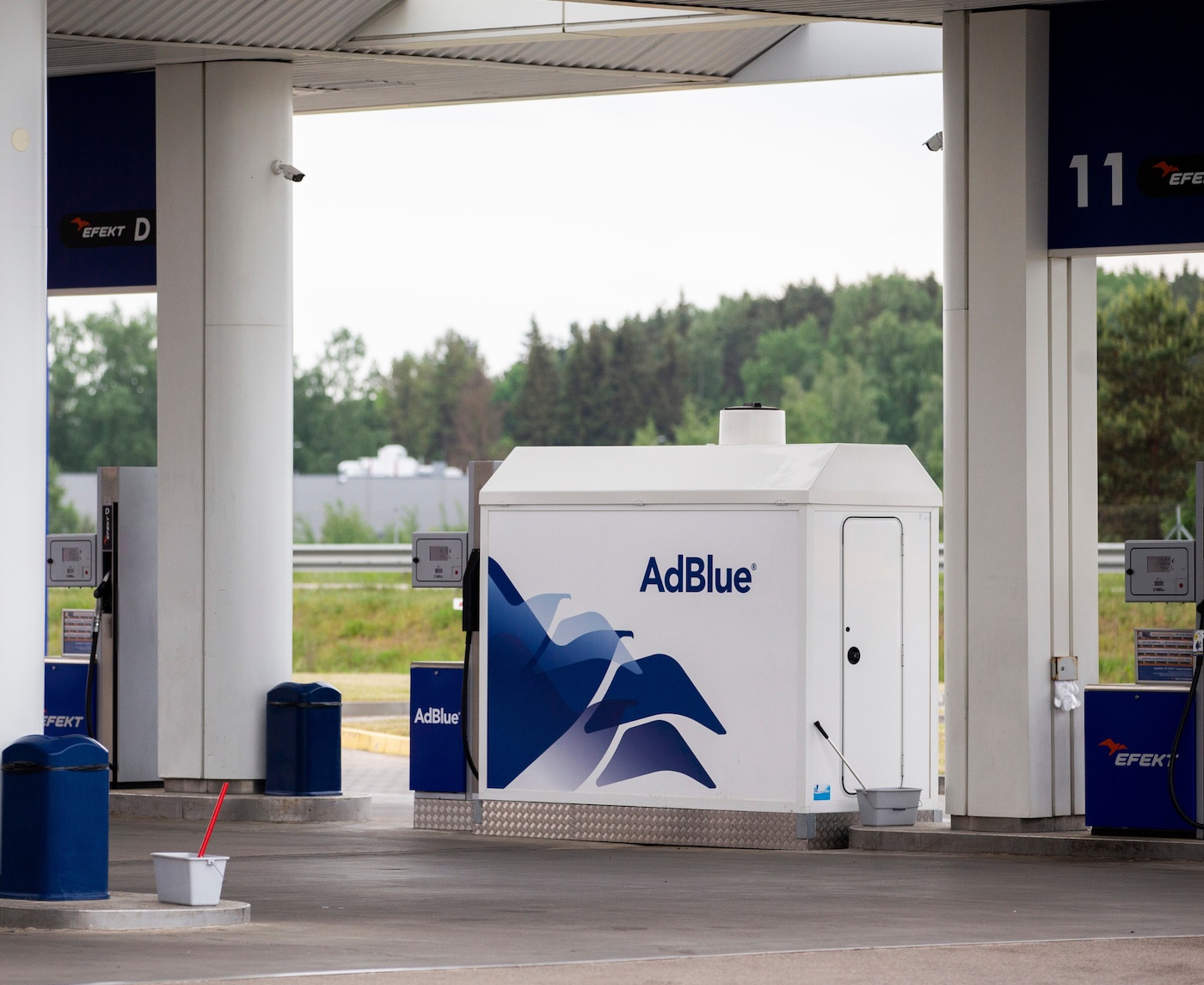
Applications: Road Vehicles vs Marine and Heavy Industry
AdBlue (AUS32) is the standard emission control fluid for the global on-road diesel vehicle sector. Any truck, bus, coach, construction machine, agricultural vehicle, or passenger car equipped with an SCR system and designed to meet Euro 4 standards or above will have been engineered to operate with AUS32. This covers the overwhelming majority of commercial diesel vehicles manufactured since the mid-2000s and sold in markets that have adopted Euro-equivalent emission regulations — including Singapore, Indonesia, the broader ASEAN region, India, China, the Gulf states, and most of Europe and the Americas.
The SCR systems in road vehicles are compact, precision-engineered units with fine injector tolerances and catalyst formulations calibrated to the specific chemical properties of AUS32. Introducing a higher-concentration fluid like AUS40 into these systems can disrupt the ammonia-to-NOx ratio in the catalyst, cause injector fouling, and in some cases permanently damage components that are expensive to replace. The same logic applies in reverse — using diluted or incorrect-concentration fluid in any SCR system undermines the entire emission reduction process and risks triggering engine management faults.
AUS40, on the other hand, was developed for the maritime sector in response to the International Maritime Organization’s progressively tightening global emission standards. It is designed for use in the large-bore, slow- and medium-speed diesel engines that power ocean-going cargo vessels, tankers, container ships, bulk carriers, ferries, and offshore support vessels. These engines operate at very different duty cycles from road vehicle engines — often running continuously for days or weeks, at high load, with exhaust gas volumes that dwarf anything produced by even the largest truck engine. The higher urea concentration in AUS40 is optimised for the SCR systems fitted to these engines, delivering efficient NOx reduction at the scale these applications demand.
AUS40 is also used in certain heavy stationary industrial applications — large diesel generators, industrial furnaces, and power generation facilities — where high-capacity SCR systems require the stronger urea concentration to achieve the required emission reduction performance.
IMO Tier III, Compliance Requirements, and the Practical Choice for Operators
For shipping companies and vessel operators, the regulatory driver behind AUS40 adoption is the IMO Tier III standard — the third and most stringent tier of the International Maritime Organization’s NOx Technical Code, which sets emission limits for marine diesel engines installed on vessels constructed on or after 1 January 2016 and operating in designated Emission Control Areas (ECAs). IMO Tier III requires an approximately 80% reduction in NOx emissions compared to Tier I levels — a target that, for most engine types, can only be achieved with SCR technology and a compatible urea solution.
The ECAs where Tier III compliance is currently mandatory include the North American coast, the US Caribbean Sea, the North Sea, and the Baltic Sea — among the world’s busiest shipping corridors. Further ECA designations are under active consideration in regions including the Mediterranean and parts of Asia. For vessel operators trading in or through these zones, AUS40 supply is not optional — it is a legal operating requirement, and failure to comply can result in port state control detentions, fines, and reputational damage that affects chartering relationships.
For fleet and vessel operators weighing the practical procurement considerations, a few points are worth keeping in mind. AUS40 is typically consumed in larger volumes per operating cycle than AdBlue in road vehicles, given the scale of marine engines and the continuous operating hours involved. This makes supply reliability and consistent product quality particularly critical in the maritime context — a vessel running low on AUS40 mid-voyage, or supplied with off-specification fluid that damages the SCR system, faces consequences far more disruptive than a truck requiring roadside attention. Bulk supply arrangements, pre-agreed delivery schedules at key ports, and certified product quality are therefore core criteria when selecting a supplier.
For operators running mixed fleets — road vehicles alongside marine assets, or commercial trucks alongside industrial generators — sourcing both AUS32 and AUS40 from a single, trusted supplier simplifies procurement, reduces vendor management overhead, and ensures consistency in product quality and documentation across the board.
The Cost and Efficiency Case
Neither AdBlue nor AUS40 should be evaluated purely on unit price. The operational costs of using substandard, incorrect, or unreliable supply far exceed any saving from sourcing cheaper, uncertified product. For road fleets, SCR catalyst replacement alone can cost several thousand dollars per vehicle. For a marine vessel, an SCR system failure or a port detention event carries costs that are orders of magnitude higher.
When used correctly and consistently, both products deliver meaningful efficiency benefits. AdBlue, used in accordance with specifications in road SCR systems, contributes to a 5–7.5% improvement in fuel efficiency by allowing engine tuning to prioritise economy over in-cylinder emission control. For AUS40 in marine applications, the NOx reduction achieved through SCR allows vessel operators to maintain engine performance at optimal load settings rather than de-rating to meet emission targets through combustion management alone — with corresponding benefits for fuel consumption and voyage economics.
Hasgara International supplies both AdBlue (AUS32) and AUS40 to commercial and industrial buyers across international markets. Hasgara’s AdBlue carries VDA certification and ISO 22241-1 compliance, and both products are supplied with consistent quality documentation to support regulatory reporting and fleet maintenance records. Whether your operation requires AUS32 for a road freight fleet, AUS40 for marine vessels, or both for a diversified industrial operation, Hasgara provides a single-source supply solution backed by an established international trading network.
To explore product specifications, packaging formats, and supply options for AdBlue (AUS32) and AUS40, visit the links below.
→ View AdBlue (AUS32) Product Page https://hasgara.sg/product/adblue-aus32/
→ View AUS40 Product Page https://hasgara.sg/product/aus40/