

Charcoal briquettes occupy an interesting position in the global fuel market. They are, in one sense, a very old technology — humans have been converting organic matter to charcoal through controlled combustion for thousands of years. In another sense, they represent a sophisticated response to the practical limitations of traditional charcoal: uneven shape, inconsistent burn characteristics, variable calorific value, and high smoke output that makes large-scale food production difficult to manage and control. The compressed briquette format, developed through industrial carbonisation and forming processes, addresses all of these limitations and in doing so has created a fuel product that is now preferred by commercial and industrial users across the food service, hospitality, and manufacturing sectors worldwide.
For procurement managers at restaurant groups, hotel chains, food manufacturers, and industrial fuel buyers, understanding what distinguishes quality charcoal briquettes from commodity charcoal — and what to look for when sourcing at scale — is directly relevant to operational efficiency, product consistency, and sustainability commitments. This article covers the full picture: how briquettes are made, how they perform against alternative fuels, why commercial operators choose them, and what bulk procurement looks like in practice.
How Charcoal Briquettes Are Produced and Why the Process Determines Performance
The production of charcoal briquettes involves two distinct stages — carbonisation and compression — and the quality of the finished product is determined as much by the process parameters applied at each stage as by the organic raw materials used.
The first stage is carbonisation: the conversion of organic raw material into charcoal through pyrolysis — controlled heating in a low-oxygen or oxygen-free environment. The raw materials used for briquette production vary by region and by product specification, but the most commercially significant and technically superior raw material for premium charcoal briquettes is coconut shell. Coconut shell charcoal has a notably high carbon content — typically 75–80% fixed carbon — compared to wood-based charcoal, which generally runs between 60–75% depending on species and carbonisation conditions. Higher fixed carbon content translates directly to higher calorific value, cleaner combustion, lower ash content, and longer burn time. This is why coconut shell briquettes command premium positioning in international export markets, particularly in the Middle East, Europe, and East Asia, where buyers specifically source them for hookah, BBQ, and professional kitchen applications.
Indonesia, with its vast coconut agricultural base and the availability of coconut shell as a processing by-product across Sumatra, Java, Sulawesi, and Kalimantan, is among the world’s principal suppliers of coconut shell charcoal briquettes — supplying into export markets that value the consistent quality profile that coconut shell raw material enables.
The carbonisation conditions — temperature, duration, and atmosphere control — determine the carbon content, volatile matter retention, and moisture level of the charcoal output. Charcoal with high residual volatile matter burns with more visible flame and produces more smoke; charcoal carbonised to higher temperatures achieves lower volatile content, cleaner combustion, and higher fixed carbon. Premium briquette production targets carbonisation temperatures in the range of 600–900°C to achieve the low volatile matter content — typically below 15%, and in premium grades below 5% — that produces the clean, nearly smokeless combustion performance that commercial buyers require.
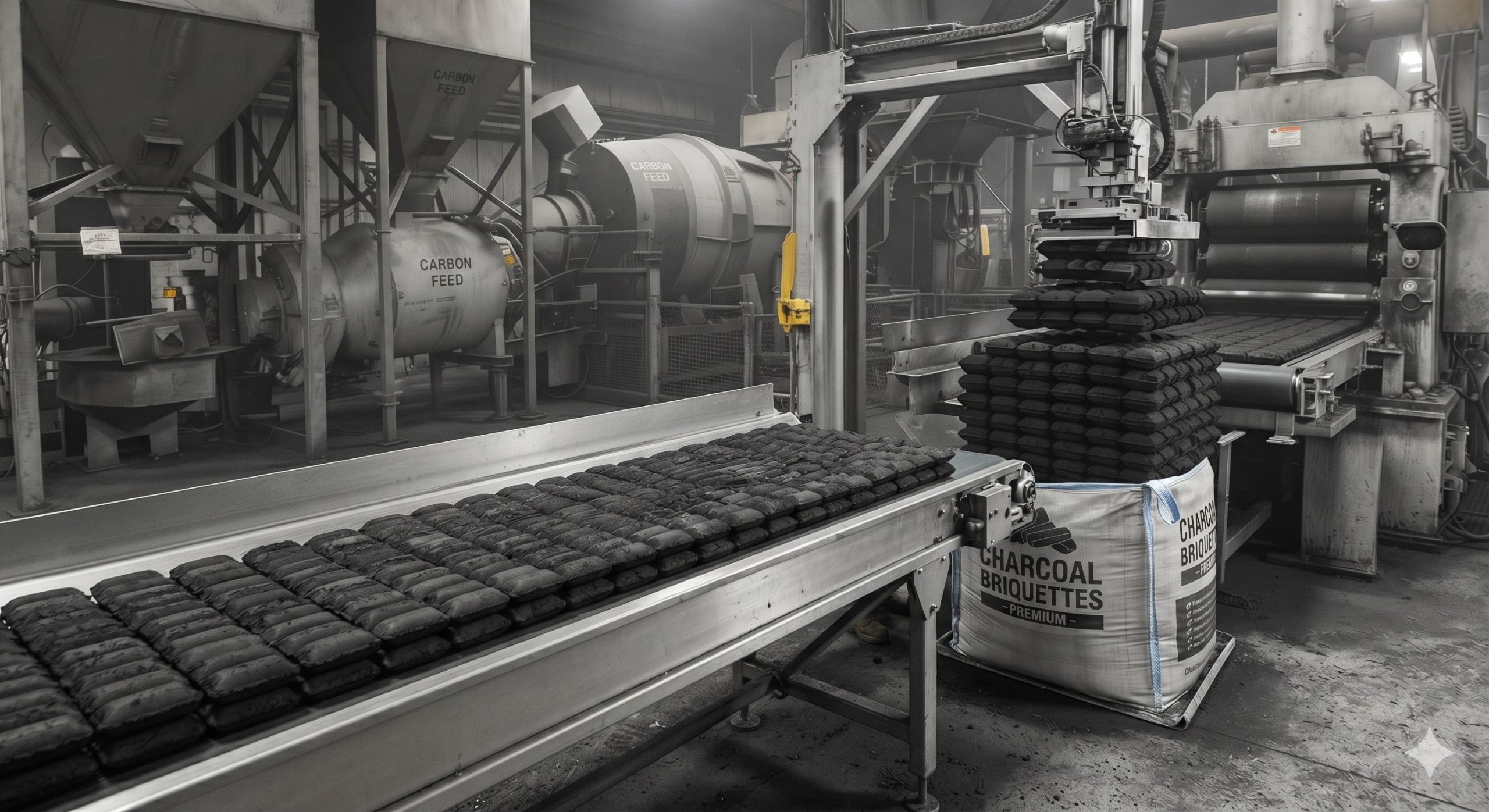
The second stage is compression. The carbonised charcoal is ground to a fine powder, mixed with a binder — typically tapioca starch or other food-safe natural binders — and compressed under high pressure into the briquette form. The binder holds the compressed charcoal particles together and burns off early in the ignition process without contributing flavour or harmful compounds to the combustion products. Briquette shape — hexagonal pillow, cubic, cylindrical, finger, or custom formats — affects packing density in the bag, airflow through the fuel bed, and heat distribution during use. Hexagonal pillow briquettes are the dominant format for BBQ and food service applications globally, offering a balance of packing efficiency and airflow.
Calorific Value, Combustion Performance, and Why Commercial Operators Choose Briquettes
The practical advantages of charcoal briquettes over both traditional lump charcoal and fossil fuel alternatives in commercial cooking and food production applications come down to four interconnected performance characteristics: calorific value, burn consistency, smoke output, and heat duration.
On calorific value, premium coconut shell charcoal briquettes typically deliver between 7,000 and 7,500 kilocalories per kilogram (kcal/kg) — a figure that compares favourably with most wood-based charcoal (5,000–6,500 kcal/kg) and is competitive with many industrial solid fuels. For reference, dry hardwood lump charcoal typically delivers 6,000–7,000 kcal/kg depending on species and preparation, while standard coal ranges from 5,500–8,500 kcal/kg depending on grade. The calorific value advantage of premium briquettes over lower-grade alternatives translates directly to fuel consumption efficiency — more heat output per kilogram purchased, and lower total fuel cost per hour of cooking or production operation.
Burn consistency is where briquettes most clearly outperform traditional lump charcoal in commercial settings. Lump charcoal, by its nature, consists of irregular pieces of varying size, density, and carbon content. The resulting fuel bed burns unevenly — hot spots and cool zones develop across the grill or cooking surface, requiring constant management. Charcoal briquettes, being uniform in size, density, and composition, produce a far more even and stable heat distribution. For restaurant grill stations turning out high volumes of protein products, and for food manufacturers using charcoal-fired kilns or ovens, this consistency translates directly to product quality uniformity and reduced labour overhead in fire management.
Low smoke output is a defining practical advantage of premium briquettes in commercial settings. Smoke in a commercial kitchen or food production facility is not merely an aesthetic nuisance — it is an occupational health consideration, a ventilation and extraction engineering constraint, and in enclosed or partially enclosed commercial spaces, a regulatory compliance issue. Quality charcoal briquettes with low volatile matter content — below 5% in premium grades — produce minimal visible smoke after ignition, making them suitable for both outdoor and indoor commercial cooking environments. For hotel banquet kitchens, large restaurant open kitchens, and food court grilling stations, the low smoke profile of quality briquettes significantly reduces extraction requirements and improves the working environment.
Burn duration is the fourth performance advantage. Quality briquettes with high fixed carbon content and dense compression maintain a stable combustion temperature for extended periods — typically three to five hours per charge in commercial BBQ use — compared to one to two hours for most lump charcoal. For commercial kitchens operating continuous service periods, longer burn duration means fewer re-lighting interruptions, lower fuel consumption per service, and more predictable heat management.

Environmental Credentials, Packaging, and Bulk Procurement Considerations
The sustainability case for charcoal briquettes — relative to fossil fuels and to some alternative solid fuels — rests on the renewable origin of the raw materials and the productive use of agricultural and processing by-products that would otherwise represent a waste management burden.
Coconut shell charcoal briquettes are produced from the shells remaining after coconut meat and water processing — a material that is generated in large volumes across tropical coconut-producing countries and that has historically been treated as low-value waste. Converting this by-product into a high-value fuel product captures economic value from the agricultural supply chain, reduces organic waste, and produces a fuel that, on a lifecycle basis, has significantly lower net carbon intensity than fossil coal — because the carbon released during combustion was recently sequestered by the growing plant, rather than being drawn from ancient geological deposits. For buyers with corporate sustainability commitments, ESG reporting requirements, or supply chain carbon accounting obligations, the bio-based origin and waste-derived raw material credentials of coconut shell briquettes are commercially relevant attributes that support both procurement decisions and sustainability communications.
For bulk procurement and export, charcoal briquettes are typically supplied in retail-format inner bags — commonly 1kg, 2kg, or 3kg pillow packs — which are then packed into master cartons for palletised ocean freight or bulk container loading. Export packaging specifications vary by destination market: buyers in the Middle East and European retail markets typically specify carton dimensions and pallet configurations that meet the requirements of their warehouse and retail distribution systems, while food service buyers may prefer larger format packs optimised for commercial kitchen usage. Moisture content management in packaging is a key quality consideration — charcoal is hygroscopic, and briquettes exposed to moisture during storage or transit will have elevated moisture content that reduces effective calorific value and extends ignition time. Quality packaging with adequate moisture barrier properties is a standard requirement for export-grade briquettes.
Hasgara International supplies charcoal briquettes — including premium coconut shell briquette formats — to commercial buyers, food service distributors, and industrial fuel procurement operations across international export markets. With flexible packaging options and an established export logistics capability, Hasgara provides the supply consistency and documentation standards that professional buyers require for large-volume procurement.