

Most people who know dolomite know it as an agricultural product — a liming material applied to acidic soils to raise pH and supply calcium and magnesium. That agricultural application is real and important, but it accounts for only part of the demand for dolomite in the global market. Across construction, glass manufacturing, steel and metal refining, ceramics, and chemical processing, dolomite is a widely used industrial mineral whose calcium magnesium carbonate composition makes it technically useful in a range of high-value applications that have nothing to do with farming.
For industrial procurement teams, understanding the range of dolomite’s industrial applications — and the quality parameters that matter for each — is the starting point for making informed sourcing decisions. This article covers the principal industrial uses of dolomite, the specifications that differentiate industrial-grade product from agricultural-grade, and what buyers should consider when evaluating bulk dolomite supply.
Dolomite in Construction, Cement, and Concrete Production
The construction industry is one of the largest consumers of dolomite globally, with applications spanning the full range of building material categories — from aggregate and fill to cement raw material and concrete admixture.
In cement manufacturing, dolomite serves as a source of both calcium and magnesium oxide in the raw mix fed to the kiln. Portland cement is produced by heating a precisely formulated mixture of calcium, silicon, aluminium, and iron-bearing raw materials to approximately 1,450°C — a process that drives off carbon dioxide and produces clinker, the intermediate product that is ground into cement. Dolomite’s calcium magnesium carbonate composition makes it a suitable component of this raw mix, particularly where the target cement specification requires controlled magnesium oxide content. However, the magnesium content in cement must be managed carefully: MgO above approximately 5% in clinker can cause delayed expansion and long-term structural instability in hardened concrete. This means that dolomite use in cement is closely tied to the overall raw mix chemistry, and cement producers source dolomite to precise chemical specifications that balance the calcium contribution against the magnesium input.
As a construction aggregate, crushed dolomite is widely used in road base and sub-base layers, concrete mixes, drainage systems, and railway ballast. Its hardness — typically 3.5 to 4.0 on the Mohs scale — and its resistance to weathering make it a durable aggregate for load-bearing applications. Dolomite aggregate is commonly specified in concrete mixes for infrastructure projects including bridges, highways, and port facilities, where a hard, chemically stable aggregate with low water absorption and good mechanical properties is required. In coastal and tropical environments, dolomite’s relative resistance to chemical weathering compared to softer limestone aggregates is a practical performance advantage.
Dolomite is also used as a filler in construction materials including asphalt, roofing products, and sealants, where its white to light grey colour, controlled particle size, and chemical inertness make it a functional and cost-effective extender and reinforcing filler.

Glass Manufacturing, Metal Refining, and Chemical Processing Applications
Beyond construction, dolomite plays important roles in several other industrial sectors where its specific chemical composition and physical properties are directly relevant to the manufacturing process.
In glass manufacturing, dolomite is a standard raw material component in the batch mix used to produce container glass, flat glass, and fibreglass. Glass is produced by melting a mixture of silica (sand), soda ash, limestone, and dolomite at temperatures exceeding 1,500°C. The calcium and magnesium oxides contributed by dolomite and limestone in the batch serve multiple functions in the final glass product: they improve chemical durability and resistance to weathering, reduce the tendency of the glass to devitrify (crystallise) during processing, and contribute to the mechanical strength and hardness of the finished product. In flat glass production for architectural and automotive applications, dolomite is consistently specified as part of the batch formulation because of the predictable, consistent chemistry it contributes. Glass manufacturers source dolomite to tight chemical specifications, particularly with respect to iron content — iron impurities impart a green tint to glass, which is unacceptable in clear architectural and optical glass applications.
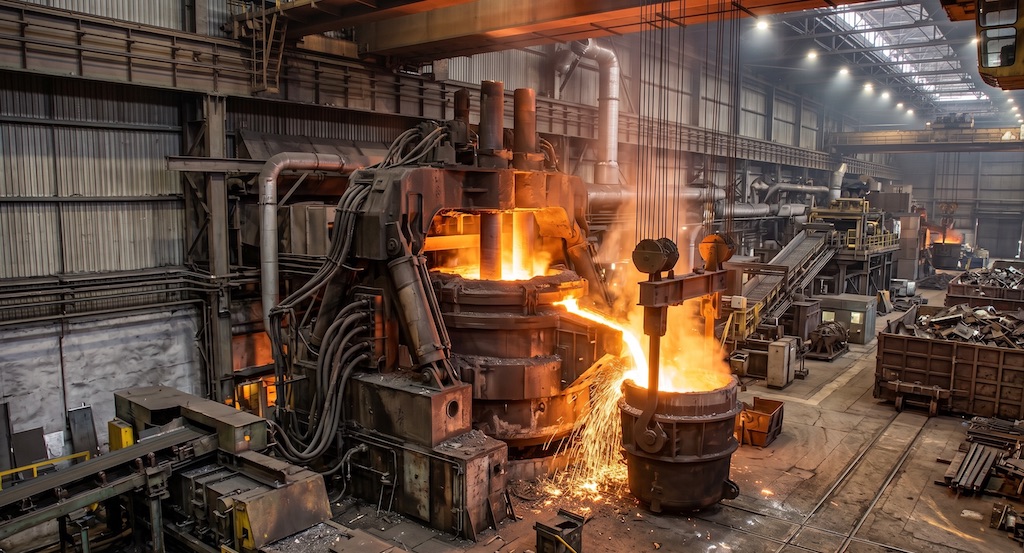
In steel and metal refining, dolomite is used as a flux and refractory material. In basic oxygen furnace (BOF) steelmaking, calcined dolomite — dolomite that has been heated to drive off carbon dioxide, leaving a mixture of calcium oxide and magnesium oxide — is added to the furnace as a flux to help control the basicity of the slag and protect the refractory lining of the furnace. The magnesium oxide in calcined dolomite stabilises the slag chemistry and reduces the rate at which the refractory brick lining is eroded by the highly basic, high-temperature slag — significantly extending furnace lining life and reducing the frequency and cost of refractory relining. Dolomite is also used in the production of magnesium metal, where it serves as a primary source material for magnesium extraction via the Pidgeon process.
In chemical processing, dolomite is used as a source of calcium and magnesium in industrial chemical synthesis, as a neutralising agent in acid waste treatment, and as a raw material in the production of magnesium compounds including magnesium hydroxide, magnesium carbonate, and magnesium sulphate — compounds that have applications in pharmaceuticals, food processing, water treatment, and industrial chemistry. The purity requirements for chemical-grade dolomite are typically more stringent than for construction applications, with tight limits on iron, silica, and other impurities that could interfere with downstream chemical processes.
Quality Specifications, Supply Chain Considerations, and Sourcing Bulk Dolomite
For industrial buyers, the quality specifications for dolomite vary significantly across applications, and selecting the right product grade is as important as securing reliable supply. The key parameters that industrial procurement teams should evaluate when sourcing dolomite include the following.
Calcium magnesium carbonate content — expressed as the combined CaCO₃ and MgCO₃ percentage, or as the equivalent CaO and MgO content — is the primary chemical specification for most applications. High-purity dolomite for glass and chemical applications typically requires combined carbonate content above 95–98%, with tight limits on silica, iron, and aluminium impurities. Construction aggregate applications are generally less sensitive to minor impurities but still require a minimum carbonate content for the product to perform correctly as a liming or neutralising material. Steel refining applications focus particularly on MgO content and the ratio of CaO to MgO, which determines the flux’s effect on slag basicity.
Particle size and gradation specifications differ substantially between applications. Construction aggregate is typically supplied in crushed and screened fractions ranging from fine chips to coarse ballast sizes. Glass batch dolomite is ground to a fine powder with a controlled particle size distribution. Agricultural dolomite is ground to a fineness that balances dissolution rate with handling properties. Chemical-grade dolomite may be required in either granular or fine powder form depending on the downstream process. Buyers should specify particle size clearly in procurement specifications and verify that supplier production capabilities match the required gradation.
Moisture content is a practical handling and logistics consideration, particularly for fine-ground products where high moisture can cause caking, bridge in hoppers and conveying systems, and complicate accurate dosing in batching operations. Bulk dolomite intended for glass or chemical use should be supplied to a controlled maximum moisture specification.
Supply chain reliability is a critical dimension of dolomite procurement that is sometimes underweighted relative to product specification. Dolomite is a high-volume, relatively low-unit-value commodity, and the economics of procurement are sensitive to shipping costs, lot sizes, and supply consistency. For industrial buyers sourcing from international markets, a supplier with established logistics capabilities, the ability to fulfil bulk orders consistently against specification, and a track record of reliable delivery scheduling reduces the working capital and operational risk associated with maintaining adequate on-site stock.
Hasgara International supplies industrial-grade dolomite to buyers across international markets, offering consistent product quality, flexible order sizes, and the supply reliability that industrial manufacturing and construction operations require. With an established international trading network and experience supplying bulk minerals to buyers in Asia and beyond, Hasgara is positioned to support both first-time qualification orders and long-term supply contracts for industrial dolomite.
To learn more about Hasgara International’s dolomite product specifications and supply capabilities for industrial buyers, visit the product page below.
View Dolomite Product Page
https://hasgara.sg/products/dolomite/