

Every litre of AdBlue (AUS32) that goes into a diesel truck, bus, or industrial engine begins its journey as a granule of urea — a white, odourless solid that is one of the most widely produced chemical compounds in the world. But not all urea is the same, and the difference between standard industrial urea and automotive grade urea is not a matter of minor specification tweaking. It is the difference between a product that protects and extends the life of precision SCR systems, and one that can damage them irreparably.
For AdBlue manufacturers, DEF producers, and industrial buyers sourcing urea at scale, understanding what makes automotive grade urea distinct — and what to look for in a supplier — is essential groundwork for maintaining product quality and SCR system reliability down the supply chain.
Automotive Grade Urea vs Industrial Urea: Why the Distinction Matters
Urea (CH₄N₂O) is produced industrially at enormous scale, primarily for use as a nitrogen-based fertiliser in agriculture. The same compound, at a different purity specification, is the core ingredient of AdBlue (AUS32) and AUS40 — the urea-based fluids used in SCR emission control systems. The chemical formula is identical, but the quality requirements are worlds apart, and using industrial-grade urea to produce AdBlue is not a viable shortcut.
The key difference lies in the impurity profile of the urea. Industrial urea produced for agricultural use is manufactured to tolerances that are entirely appropriate for soil application, where trace impurities have negligible impact on function. The SCR catalyst inside a diesel engine or marine vessel, however, is an extremely sensitive piece of equipment. It is engineered to react specifically with ammonia derived from high-purity urea decomposition, at precise concentrations, without interference from contaminants. Impurities that are harmless in a field can, in an SCR system, poison the catalyst, block injector nozzles, cause uneven ammonia distribution across the catalyst face, and accelerate system degradation — leading to NOx conversion failure, engine management faults, and expensive component replacement.
The most critical purity parameter in automotive grade urea is the biuret content. Biuret is a by-product of urea synthesis that forms when urea molecules are exposed to excessive heat during production, causing them to condense and bond together. Even at low concentrations, biuret is harmful to SCR catalysts — it decomposes in the exhaust stream into compounds that accumulate on the catalyst surface, progressively reducing its active area and NOx conversion efficiency. Automotive grade urea is therefore produced under carefully controlled manufacturing conditions, with biuret levels held well below the thresholds that would damage SCR systems. ISO 22241-1, the international standard for AUS32, specifies a maximum biuret content of 0.3% in the finished AdBlue solution — and the raw urea used to produce it must meet correspondingly tight biuret specifications to allow this target to be achieved consistently.
Urevo and Urevo+: Hasgara’s Automotive Grade Urea Products
Hasgara International supplies automotive grade urea under two product designations — Urevo and Urevo+ — both of which are specifically formulated for use in AdBlue and DEF manufacturing, as well as in SCR systems for automotive, industrial, and maritime applications.
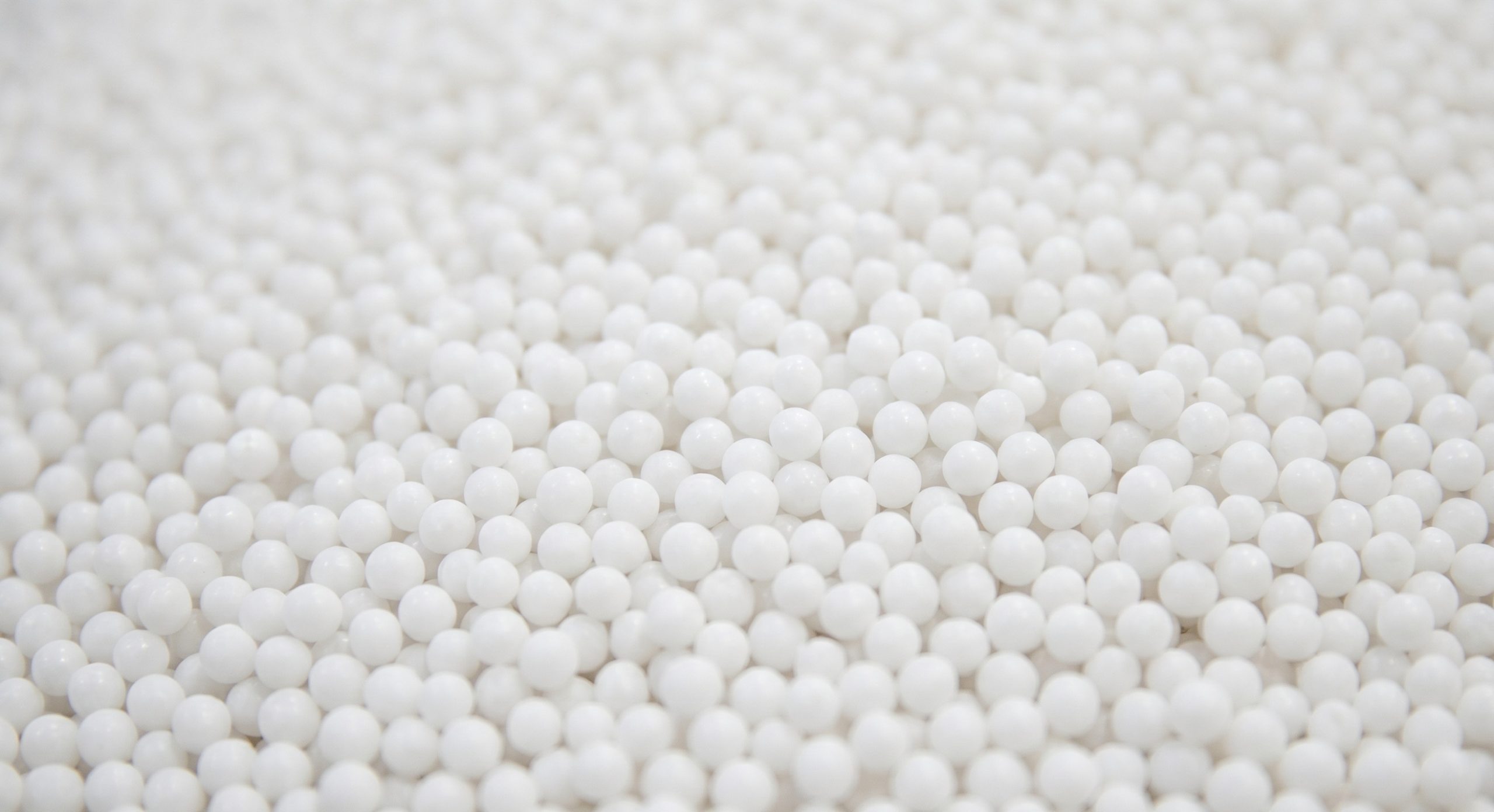
Both Urevo and Urevo+ are produced as white prilled granules — a form factor that offers practical advantages in handling, blending, and dissolution. Prilled urea dissolves more uniformly in deionised water than compacted or crystalline forms, which is important when producing AUS32 at the 32.5% concentration required by ISO 22241-1. The prilled format also reduces dust generation during handling, which matters for both product quality control and the working environment in production facilities.
The key difference between the two products is their biuret specification. Urevo carries a biuret level below 0.9%, which meets the requirements for a wide range of AdBlue production and industrial SCR applications. Urevo+, by contrast, holds biuret content below 0.5% — a significantly tighter specification that reflects a higher level of manufacturing control and product purity. For AdBlue producers supplying to markets with stringent quality requirements, for manufacturers of high-performance SCR systems, or for applications where catalyst longevity is a critical operational and commercial factor, Urevo+ provides the additional purity margin that eliminates biuret as a variable in product quality and system performance.
Both products carry a nitrogen content of 46% (N46%), which is the standard specification for prilled urea used in AdBlue production. The nitrogen content is directly related to the urea concentration of the finished solution — and consistent N46% specification means that AdBlue producers can rely on predictable, reproducible blending ratios when manufacturing AUS32 to ISO 22241-1 tolerances.
How Urea Is Processed Into AdBlue (AUS32)
The production of AdBlue from automotive grade urea is, in principle, a straightforward dissolution process: high-purity urea is dissolved in deionised water at a precisely controlled ratio to produce a 32.5% urea solution. In practice, however, the quality of the finished product is only as good as the purity of the two inputs — the urea and the water. Deionised water of the correct specification removes the ionic impurities that could otherwise react with urea decomposition products and affect SCR catalyst performance. Automotive grade urea with controlled biuret and contaminant levels ensures that no harmful compounds are introduced into the solution during blending.
The production process also requires careful temperature management, as urea dissolves exothermically and the solution must be maintained within the temperature ranges specified under ISO 22241-1 to prevent degradation. Finished AdBlue is then filtered, tested against the full ISO 22241-1 parameter set — including urea concentration, density, pH, alkalinity, biuret, and a suite of trace metal and ion limits — before being packaged or transferred to bulk storage for distribution.
For AdBlue producers sourcing urea raw material, consistent batch quality from the urea supplier is not simply a procurement preference — it is a production quality control requirement. Variation in biuret levels, moisture content, or trace impurity profiles between batches introduces variability into the finished AdBlue and can push product towards or beyond the ISO 22241-1 specification limits, creating compliance risk and potential customer claims.
Packaging, Logistics, and the Non-DG Advantage
For buyers sourcing automotive grade urea at industrial scale, packaging flexibility and logistics simplicity are practical considerations that affect total landed cost and operational efficiency as much as the product specification itself.
Hasgara’s Urevo and Urevo+ are available in two primary packaging formats. The 50kg bag option is well-suited to smaller AdBlue production operations, blending facilities with limited bulk storage capacity, and buyers who require flexibility in lot sizing or who are introducing a new product into their manufacturing process and prefer to qualify at a smaller scale before moving to bulk procurement. The 1MT jumbo bag (bulk-in-bag) format is the standard choice for larger AdBlue production operations and industrial buyers, offering the handling and storage efficiency of bulk product in a format that is compatible with most industrial material handling systems without requiring dedicated bulk liquid infrastructure.
One logistics advantage that is often underappreciated in urea procurement is the Non-DG (Non-Dangerous Goods) classification of automotive grade urea. Unlike many industrial chemicals, urea is not classified as a dangerous good under international transport regulations — it does not require hazmat placarding, special vehicle permits, restricted routing, or the additional documentation and handling protocols that DG shipments typically involve. This classification simplifies logistics considerably, both for domestic distribution and for international export shipments. It broadens the range of freight forwarders, carriers, and logistics providers able to handle the product, reduces compliance overhead in the shipping process, and often translates to lower freight costs compared to equivalent DG chemical shipments.
For buyers importing urea into markets with strict customs and import controls on industrial chemicals, the Non-DG status of automotive grade urea also streamlines the import clearance process — an advantage that compounds across multiple shipments over the course of a supply relationship.
Hasgara International’s established international trading network means that Urevo and Urevo+ can be delivered to buyers across Asia, the Middle East, and other international markets with the supply continuity and documentation standards that industrial procurement processes require. Whether you are scaling up AdBlue production capacity, qualifying a new raw material source, or looking for a reliable long-term urea supplier with consistent quality and flexible packaging, Hasgara provides a supply solution built around the practical requirements of industrial buyers.
To learn more about Urevo and Urevo+ specifications, packaging options, and supply arrangements, visit the product page below.
→ View Automotive Grade Urea (Urevo / Urevo+) Product Page https://hasgara.sg/products/automotive-grade-urea/