

If you operate diesel-powered trucks, buses, or commercial vehicles, you have almost certainly come across the term AdBlue — or its technical designation, AUS32. But what exactly is it, how does it work, and what happens if you ignore it? Whether you manage a logistics fleet, source industrial fluids, or are simply looking to understand modern diesel emission systems, this guide covers everything you need to know.
What Is AdBlue and How Does It Work in SCR Systems?
AdBlue® is the registered trade name for Diesel Exhaust Fluid (DEF), standardised internationally under the designation AUS32 — Aqueous Urea Solution 32.5%. It is a non-toxic, colourless liquid composed of 32.5% high-purity automotive grade urea dissolved in 67.5% deionised water. Despite being stored on the vehicle, it is not a fuel additive — it has its own dedicated tank and injection system, completely separate from the fuel circuit.
AdBlue is the consumable fluid that makes Selective Catalytic Reduction (SCR) technology possible. SCR is the after-treatment system now built into virtually every diesel engine designed to meet Euro 4, Euro 5, or Euro 6 emission standards. Here is how the process works: as the engine runs, combustion produces nitrogen oxides (NOx) — a group of highly reactive gases responsible for smog, acid rain, and serious respiratory health problems. Before these exhaust gases exit the tailpipe, they pass through the SCR catalyst. At that point, AdBlue is injected into the hot exhaust stream, where heat causes the urea to decompose into ammonia (NH₃). Inside the catalyst, that ammonia undergoes a reduction reaction with the NOx, converting toxic gases into two entirely harmless substances: nitrogen (N₂) and water vapour (H₂O).
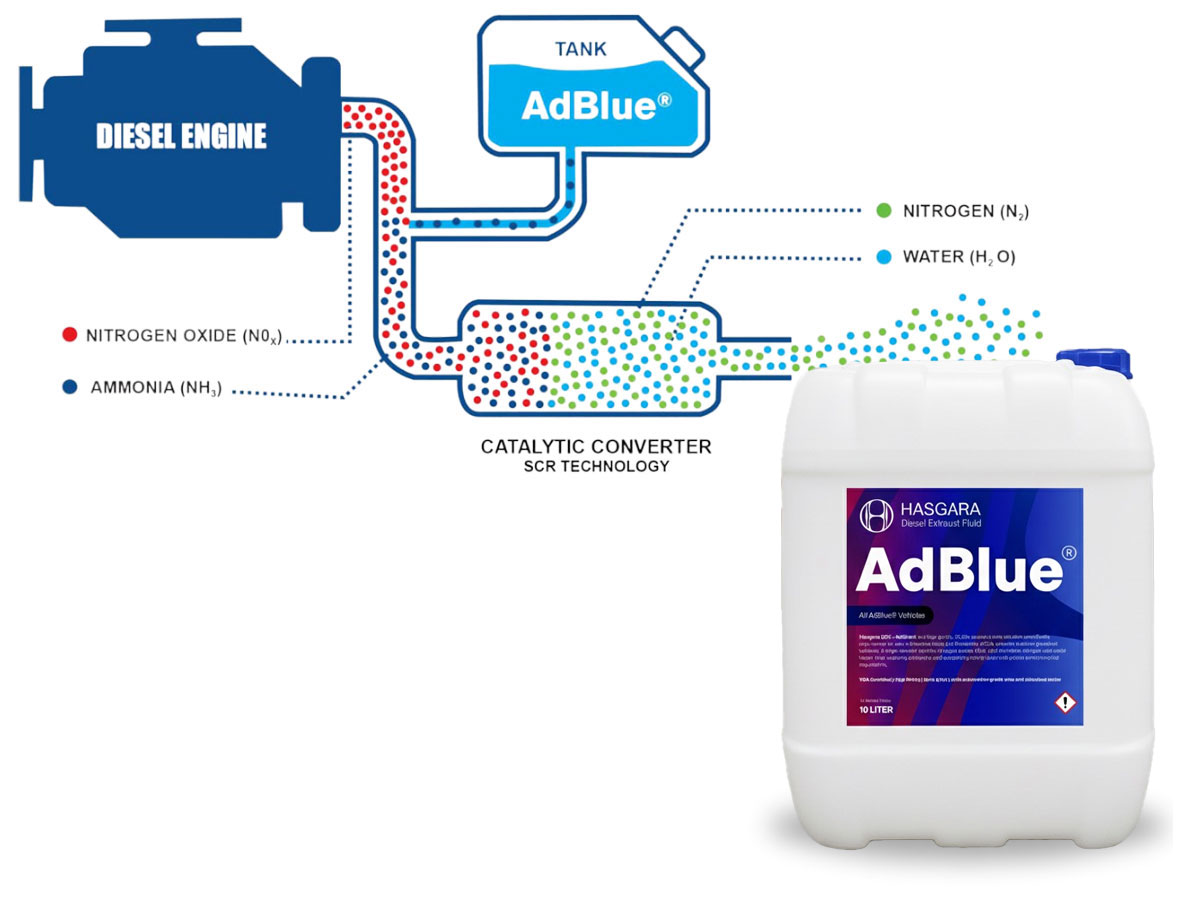
The 32.5% urea concentration is not arbitrary. It is the scientifically optimised ratio — the eutectic point — at which the solution freezes at the lowest possible temperature (–11°C), while delivering maximum NOx conversion efficiency. This precise formulation is defined under ISO 22241-1, the international quality standard that governs AdBlue production, testing, packaging, and handling. Hasgara International’s AdBlue is also certified to the VDA (Verband der Automobilindustrie) standard — the German Automotive Industry Association quality mark that is among the most recognised and trusted certifications for AdBlue globally, accepted by OEMs and fleet operators across Europe and international markets.
Which Vehicles and Engines Require AdBlue?
Any diesel vehicle or engine fitted with an SCR system will require AdBlue as part of its regular operation. On the road, this includes heavy-duty freight trucks, long-haul lorries, city and inter-city buses, construction and mining equipment, agricultural tractors, and a growing range of passenger diesel cars compliant with Euro 5 and Euro 6 standards. In industrial settings, AdBlue is used in diesel generators, stationary power plants, and rail locomotives equipped with SCR after-treatment systems. For large marine vessels and offshore engines operating under IMO Tier III international maritime emission standards, a higher-concentration variant — AUS40 (40% urea solution) — is used instead.

Euro Emission Standards: What They Mean and Why They Matter
The Euro emission standards are a series of European Union regulations that set legally binding limits on exhaust pollutants — including NOx, particulate matter, and hydrocarbons — for all new vehicles sold within the EU and in the many countries worldwide that have adopted equivalent frameworks. Each successive standard tightens the permitted NOx limit significantly, and it is this escalating requirement that has made SCR technology — and therefore AdBlue — an engineering necessity rather than an option.
Euro 4, introduced for heavy-duty vehicles in 2005, set a NOx limit of 3.5 g/kWh. Euro 5, which followed in 2008, reduced that limit to 2.0 g/kWh and was the first standard at which SCR systems became the dominant technical solution for most engine manufacturers. Euro 6, in force since 2013 for heavy-duty vehicles and progressively tightened since then, cuts the NOx limit to just 0.4 g/kWh — a reduction of over 95% compared to pre-Euro levels. Meeting that target without a fully functioning SCR system and a continuous supply of high-quality AdBlue is, from an engineering standpoint, not feasible.
Beyond Europe, equivalent frameworks have been adopted across Asia, the Middle East, Latin America, and Africa. Markets including Singapore, Indonesia, India (Bharat Stage VI), China (China 6), and the Gulf Cooperation Council countries have all implemented or are actively transitioning to Euro-equivalent emission standards. For fleet operators and industrial buyers in these regions, understanding AdBlue requirements is increasingly a compliance obligation, not merely a best practice.
The Commercial Case for Consistent AdBlue Use
Beyond regulatory compliance, there is a straightforward operational and financial argument for using quality AdBlue consistently. When used according to specifications, AdBlue contributes to a 5–7.5% improvement in fuel efficiency, because the SCR system allows engine calibration to be optimised for power and economy rather than being constrained by in-cylinder emission reduction strategies. Over the lifetime of a commercial fleet, that fuel saving is significant. Additionally, by reducing the thermal and chemical stress on diesel particulate filters and EGR systems, a properly functioning SCR setup extends the service intervals and overall lifespan of critical engine components — reducing maintenance costs and unplanned downtime.
The Real Consequences of Running Out or Using Low-Quality AdBlue
One of the most common and costly mistakes fleet operators make is treating AdBlue as an afterthought — either letting tanks run low or sourcing from uncertified suppliers to cut costs. Both decisions carry serious operational and financial risks that far outweigh any short-term saving.
When a vehicle’s AdBlue tank runs dry, the consequences are not minor. Modern SCR-equipped trucks and buses are designed by their manufacturers to progressively derate engine power as the AdBlue level drops below a threshold — typically reducing torque output and limiting speed. Once the tank is empty, many vehicles will not restart. This is an intentional design feature to enforce emissions compliance, but the practical result for a fleet operator is an immobilised vehicle, a disrupted delivery schedule, and a recovery operation that could have been avoided with basic stock management. In a logistics or construction context, a single unplanned vehicle-down incident can cost multiples of what a bulk AdBlue supply contract would have cost over months.
The risks from substandard or contaminated AdBlue are, if anything, more severe in the long run. The SCR catalyst — the core component of the emission control system — is precisely engineered to function with a urea solution of exactly 32.5% concentration and very strict purity specifications. Diluted AdBlue reduces NOx conversion efficiency and triggers fault codes and warning lights. Contaminated AdBlue — product that contains impurities from poor manufacturing processes, inadequate packaging, or improper storage — can permanently damage the SCR catalyst and block the fine-tolerance injector nozzles. SCR catalyst replacement is a major repair, with component costs that can reach several thousand dollars depending on the vehicle. Non-compliant AdBlue can also void the vehicle manufacturer’s warranty and expose operators to regulatory penalties in markets with roadside emissions enforcement.
Why Certification Is the Most Important Buying Criterion
For procurement teams and fleet managers, the single most reliable way to manage AdBlue risk is to source exclusively from suppliers whose product carries verifiable third-party certification. ISO 22241-1 compliance confirms that the product meets the international specification for urea concentration, purity, and stability. VDA certification — the standard set by the German Automotive Industry Association and referenced by major European truck and engine OEMs — adds an additional layer of assurance that the product has been independently tested and approved against the requirements that vehicle manufacturers themselves use.
Hasgara International supplies AdBlue (AUS32) that is certified to both VDA and ISO 22241-1 standards, providing buyers with documented quality assurance on every shipment. As a global trading company with an established supply network across Asia and international markets, Hasgara combines product quality with supply reliability — two factors that are equally critical for any operation that depends on uninterrupted AdBlue availability.
Whether you are managing a cross-border freight fleet, procuring for a distributor network, or sourcing AdBlue at industrial scale, the cost of quality is always lower than the cost of system failure.
To learn more about Hasgara International’s AdBlue (AUS32) product specifications, packaging options, and supply capabilities, visit the product page: https://hasgara.sg/products/adblue-aus32/